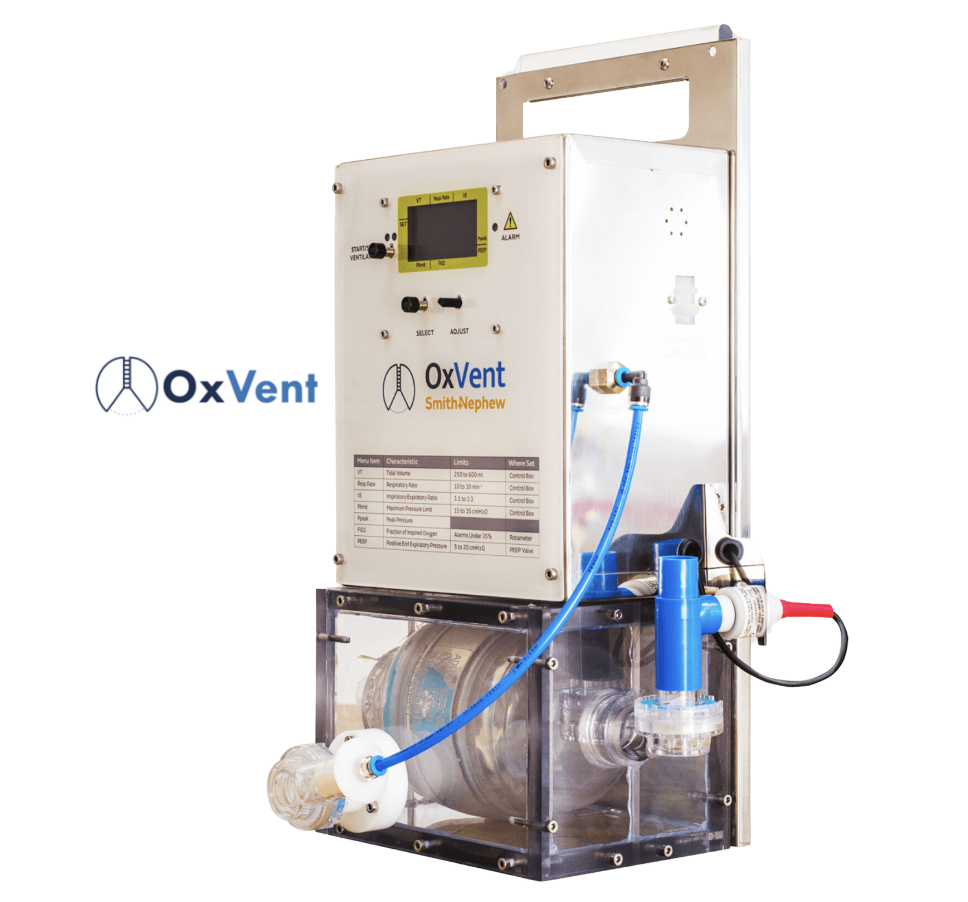
OxVent – prototype ventilator
OxVent

Solution Overview & Benefits
The OxVent is a low-cost, rapidly deployable mechanical ventilator designed to address ventilator shortages in emergencies, such as the COVID-19 pandemic. It is engineered to be easy to manufacture and operate using readily available components, making it ideal for low-resource settings.
Benefits:
- Affordable: Provides a cost-effective solution compared to traditional ventilators.
- Easy to Manufacture: Designed with readily available components for fast production.
- Scalable: Ideal for emergency use in hospitals, particularly in resource-limited areas.
- Life-Saving: Helps meet urgent needs for respiratory support in crises.
History & Development
Multidisciplinary team of engineers and medics at the University of Oxford and King’s College London. Leadership: Prof. Andrew Farmery, (consultant anesthetist) Head of the Nuffield Division of Anesthetic.
It’s a compressible bag, the sort used to resuscitate patients who have collapsed from cardiac arrest, similar to ones carried in Ambulances. The bag is enclosed within a rigid Perspex box. Compressed air is injected into the rigid Perspex box that squeezes the bladder and pushes air out through some valves and inflates the patient’s chest. There’s a second set of valves that allows gas to come out of the patient’s chest and also out of the rigid Perspex box. So it’s a sort of electro-pneumatic device. Pressure, breath rates, length of inhalation and exhalation , and volume is controlled with a feedback controller using Arduino – a simple opensource microcontroller. Device awaiting MHRA approval. Manufacturer – Smith+Nephew (Hull, UK).

Availability
- Publicly available: No
- Countries where available: United Kingdom - Currently seeking approval from the Medicines and Healthcare products Regulatory Agency
- Price range: Over 200 USD
- Offered or can be licensed for local manufacture: Yes
Specifications
Summary Specs:
- This is Pressure Regulated Volume Control (PRVC) device.
- Max Pressure limit – 15 to 35 cmH20
- PEEP range 5 to 20 cmH20
- FiO2 alarms; other alarms required by MHRA may be present
- Displays for Plimit, VT, Resp rate, IE, FiO2, Ppeak, PEEP.
- How long can it run without interruption? (standard is 100% for 14 days)? Undergoing review by MHRA; so, device can potentially run for atleast 14 days but need further information.
- IE ratio – 1:1 to 1:3
- Respiratory rate – 10 to 30 per min
- Tidal volume - 250 to 600 ml
Additional Information
Similar solutions...
Get in Touch!
Get in touch with us by filling out the form or emailing us at contact@techxlab.org.