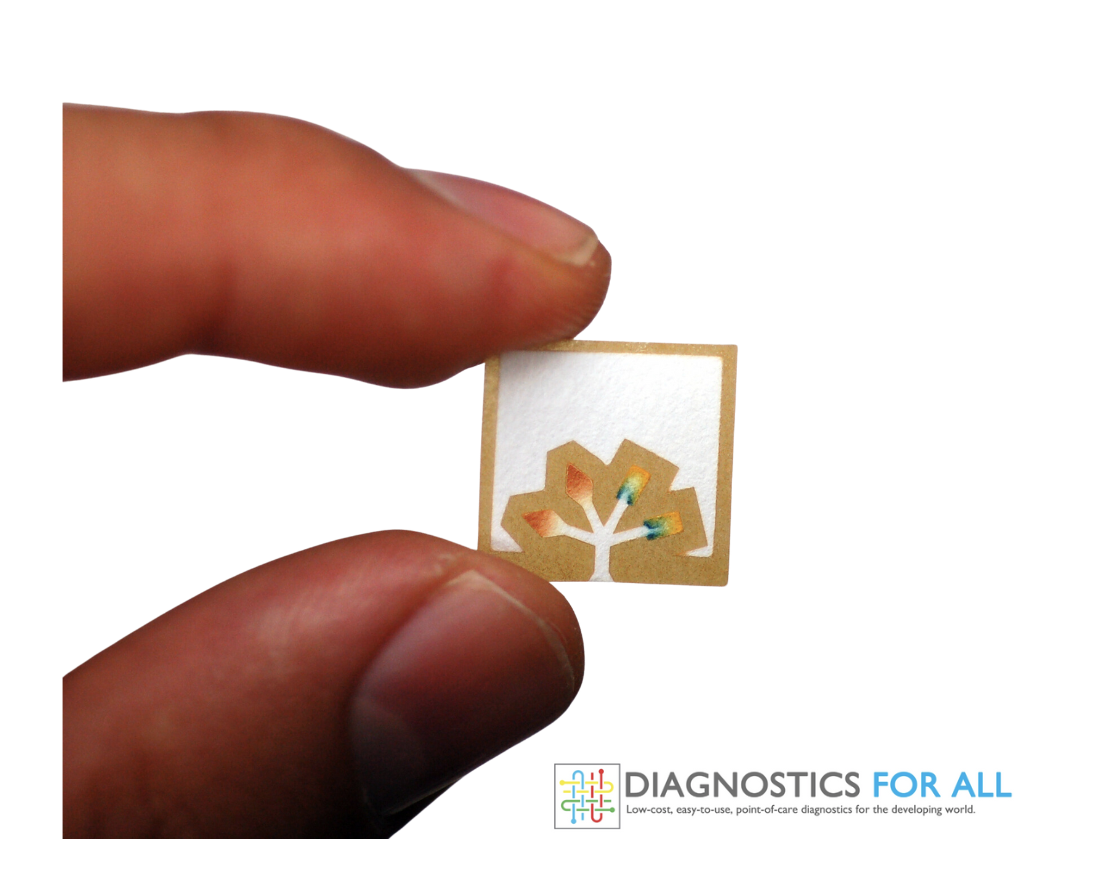
Paper for diagnostic devices (DFA)
Diagnostics For All

Solution Overview & Benefits
Patterned paper is a game-changing technology for delivering low-cost diagnostic devices to support human and economic development in the developing world. This technology, which underlies our devices, was developed by Professor George Whitesides and his team at Harvard University. DFA holds an exclusive worldwide license from Harvard for medical and other applications of the technology.
How it Works
Paper is inexpensive, universally available, and compatible with many biological and chemical assays. To fabricate a diagnostic device, DFA patterns channels and assay zones (or wells) into a piece of paper roughly the size of a postage stamp. These wells also contain biological and chemical assay reagents to catalyze the desired diagnostic test. When a biological sample—like blood, urine, saliva, or sweat--is applied to the device, the paper wicks the sample through the channels to the assay zones to process the biochemical reaction. Upon contact, the assay zone changes color; these results are then easily read by comparing the color change with a reference scale printed on the device.
- Liver Function: To address these obstacles and to make liver function testing a standard of care worldwide, DFA has developed a low-cost, patterned paper-based, liver enzyme diagnostic test that can provide an assessment of liver health from a single drop of blood in about 15 minutes. The DFA liver function test (LFT) could provide invaluable information to healthcare providers in rural settings and could have a dramatic impact on patient care in the developing world.
- Small Farmer Support
- Nucleic Acid Detection
- Child Nutrition
- Immunity
Advantages
- Chemically versatile - The patterned paper technology can be applied to create immunoassasys, electrochemical assays, clinical chemistry assays, and molecular diagnostics.
- Easy-to-use and easy-to-read – Paper diagnostics require minimal training to use and read. They are both user-friendly and minimally invasive. A sample from a finger prick is sufficient to yield results: no need for syringes, clean water, nor sample preparation. Results are quickly displayed, enabling immediate clinical decisions.
- Inexpensive - Paper is significantly less expensive than other typical materials. Additionally, its ability to "wick" samples and reagents eliminates the need for external pumps or other laboratory equipment. Patterned paper-based devices can be manufactured to scale using existing high-volume, low-capital techniques and equipment.
- Portable - DFA’s patterned paper-based devices are small and lightweight, making them easy to bring directly to those who are unable to travel to hospitals or clinics. The devices, with no mechanical parts, are robust enough for use under severe environmental conditions. No auxiliary equipment, electricity, or laboratory facility is needed to use the device or process a sample.
- Disposable - DFA’s patterned paper-based devices are single-use, and they can be easily and safely disposed of through incineration, assuring that they do not contribute to the growing problem of global medical waste.
History & Development
Diagnostics For All is a non-profit enterprise saving lives through the creation of low-cost, easy-to-use, point-of-care diagnostic devices designed specifically for the developing world.
DFA was founded in 2007 by a group of scientists and entrepreneurs with a shared commitment to saving lives and alleviating disease in developing countries and other resource-poor settings through low-cost, innovative, practical diagnostic devices.
DFA relies on a broad spectrum of financial donations and pro-bono contributions that help to support everything from our technology development to our regular organizational operations. We combine the power of strategic partnerships, grant-giving organizations, and individual donors to support our work across the globe.
As a design-based organization, DFA also seeks opportunities for private-public partnerships to collaborate with manufacturers to sell our devices at low-margin to high-need developing markets. As our products leave the lab and enter the market, we will generate additional revenue through licensing our technology to corporate partners for use in the developed world. Proceeds from these licenses are used to further support our technology development and mission for the developing world.

Availability
- Publicly available: no (partnerships available)
- Countries where available: Worldwide
- Price range (USD): contact solution provider
Specifications
Additional Information
Similar solutions...
Get in Touch!
Get in touch with us by filling out the form or emailing us at contact@techxlab.org.